
Deductions and Short-Pays: What AI Resolves Before A/R Sees Them
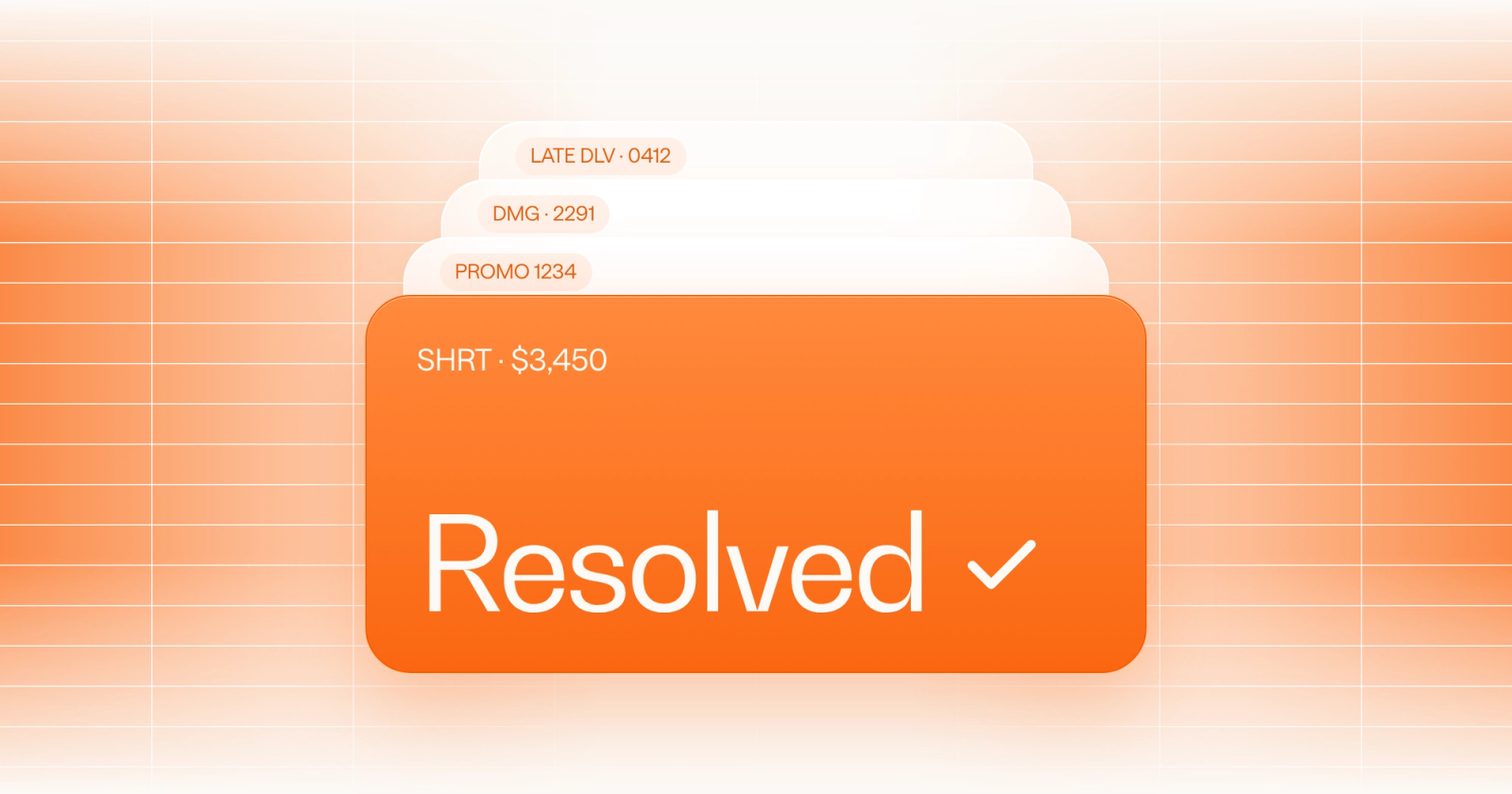


If you sell physical goods to retailers, distributors or big-box customers, you already know the pattern. An invoice goes out for $48,200. A payment comes back for $44,750. No explanation in the remittance, or a cryptic comment like "PROMO 1234" or "SHRT." Somewhere in the short payment is a promotional allowance, a pricing dispute, a shortage claim, a late-delivery fine or a bank fee deduction. Now someone in Accounts Receivable now has to figure out which and for how much.
Multiply that by hundreds or thousands of payments a month and you get margin quietly leaking out of the business, cash tied up in unresolved balances, and an A/R team that spends its days as investigators instead of collectors.
At Hyphenate, we think most of that detective work should be done before a human ever gets involved. Here is what AI can resolve on its own and what it hands to your team.
Why deductions are so hard to work
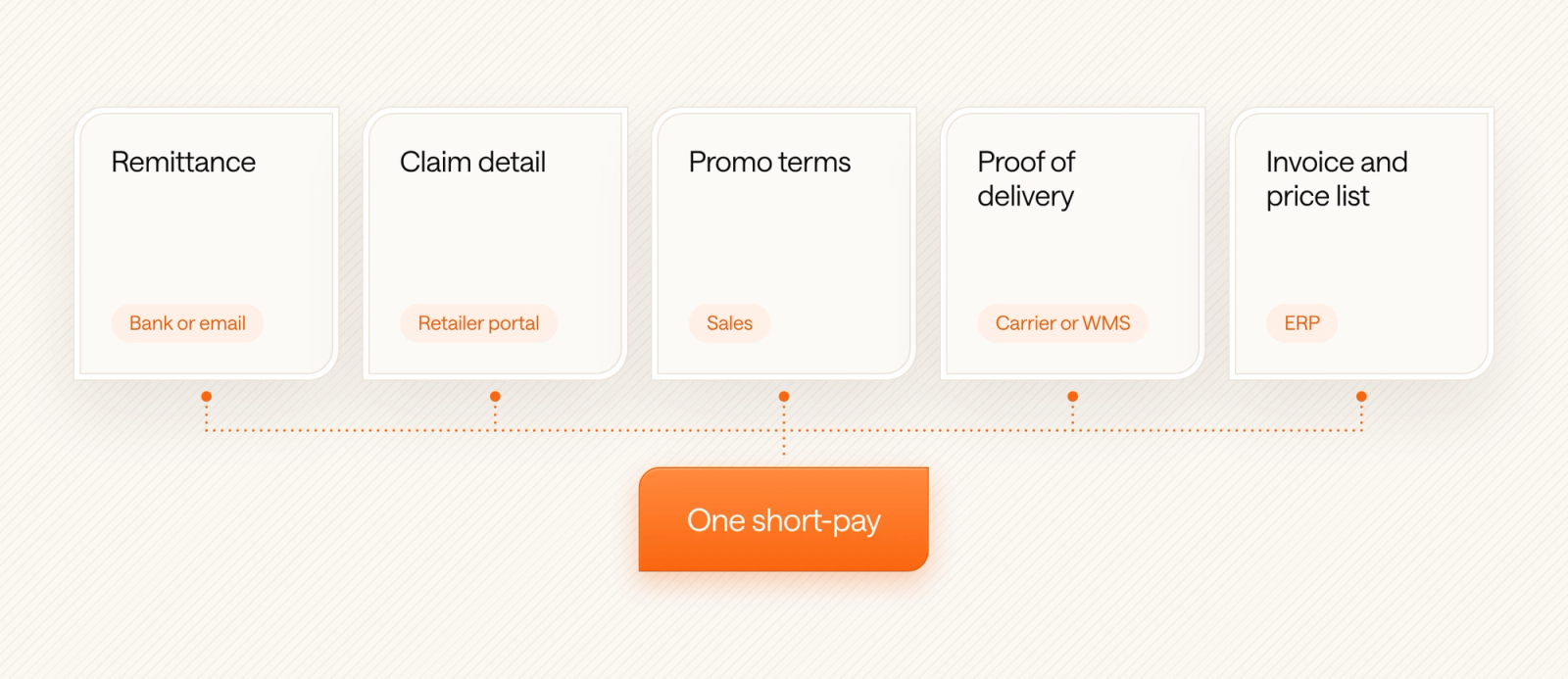
Deductions are not hard because any single one is complicated. They are hard because the evidence for each one lives in five different places.
- The backup is scattered. The remittance is in a bank file or email. The claim detail sits in a retailer portal. The promo agreement lives with sales. Proof of delivery is in the carrier or WMS system. The original invoice and price list are in the ERP.
- Every customer speaks a different language. Each retailer and distributor has its own reason codes, portal, claim format and dispute process.
- Valid and invalid deductions look the same on arrival. A legitimate trade promotion and an erroneous shortage claim both show up as a short-pay. Only the backup tells them apart.
- Dispute windows are short. Many customers only accept disputes for a limited time. A deduction that sits in a queue for six weeks is often a deduction you have already lost.
- The work is manual and repetitive. Analysts download claims, match them to invoices, look up promotions, request proof of delivery documents and write dispute letters. The same steps are repeated over and over again.
The end result is teams triage by dollar amount, write off the small stuff, and never get to the root causes that keep generating new deductions.
What AI resolves before AR sees it
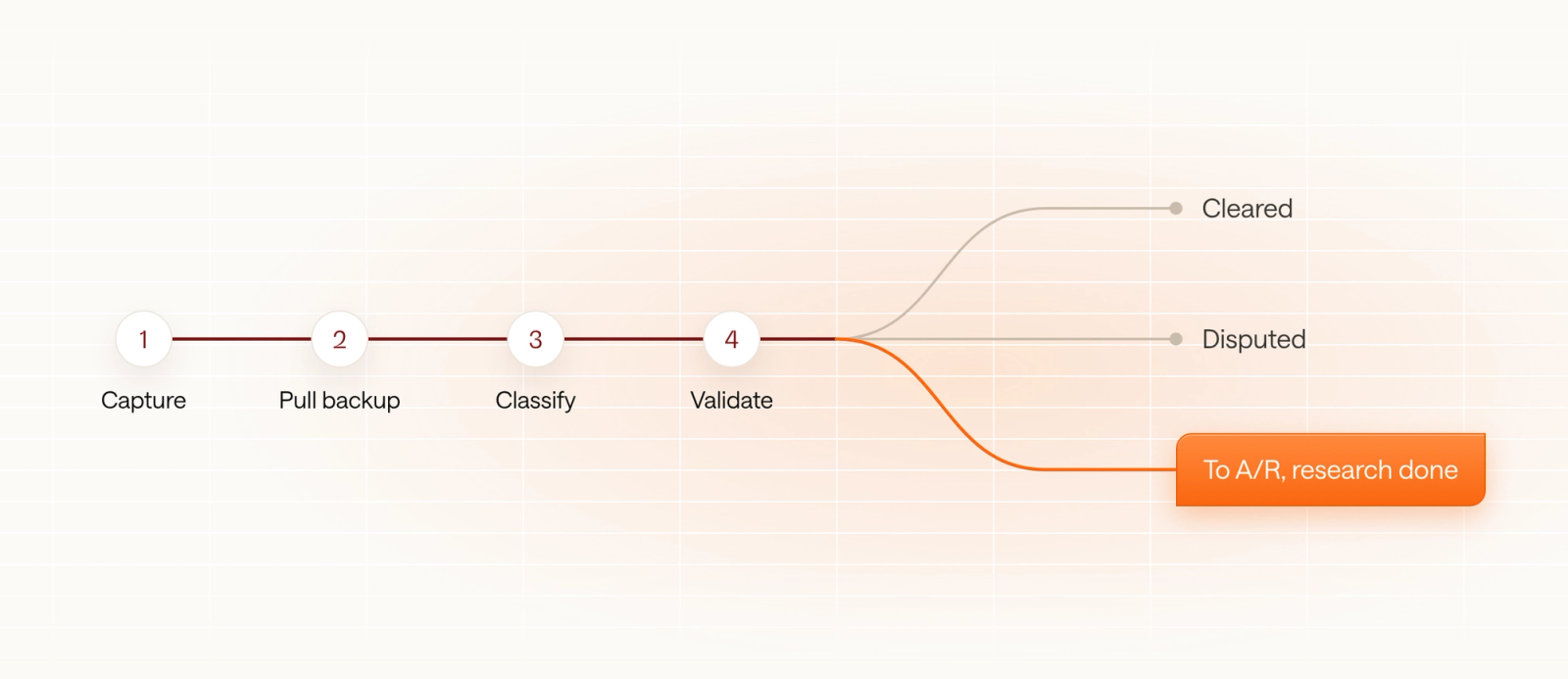
Most deductions can be researched, classified and either cleared or disputed without a person touching them. The job of AI is to do the assembly work so your team only sees exceptions that need judgment.
- 01Capture every short-pay as it lands. AI reads remittances from bank files, emails and PDFs, splits out each deduction line, and flags the differences before cash is even applied.
- 02Pull the backup automatically. It retrieves claim detail, the matching invoice and order from the ERP, proof of delivery from carrier or warehouse systems, and the relevant promotion or contract terms.
- 03Classify the reason. Cryptic comments and free-text notes are mapped to a consistent set of categories: trade promotion, pricing, shortage, damage, returns, compliance fines, freight, and more.
- 04Validate against the evidence. Is the deduction real, active and correctly priced? Does the proof of delivery show full delivery? Does the claimed price match the agreed price list? Each deduction is evaluated and surfaced for review.
- 05Clear what is valid. Legitimate deductions are matched to accruals, coded to the right GL account and closed with no manual intervention required.
- 06Dispute what is not. For invalid deductions, AI drafts the dispute with the supporting documents attached, formatted for that customer's process, and tracks it until it is repaid.
- 07Route the rest. Anything ambiguous goes to the right owner in A/R, sales, customer service or logistics with the research already done and a recommended action.
By the time an analyst opens their queue, the easy deductions are closed and the hard ones arrive with a full audit trail instead of a blank screen.
How Hyphenate works
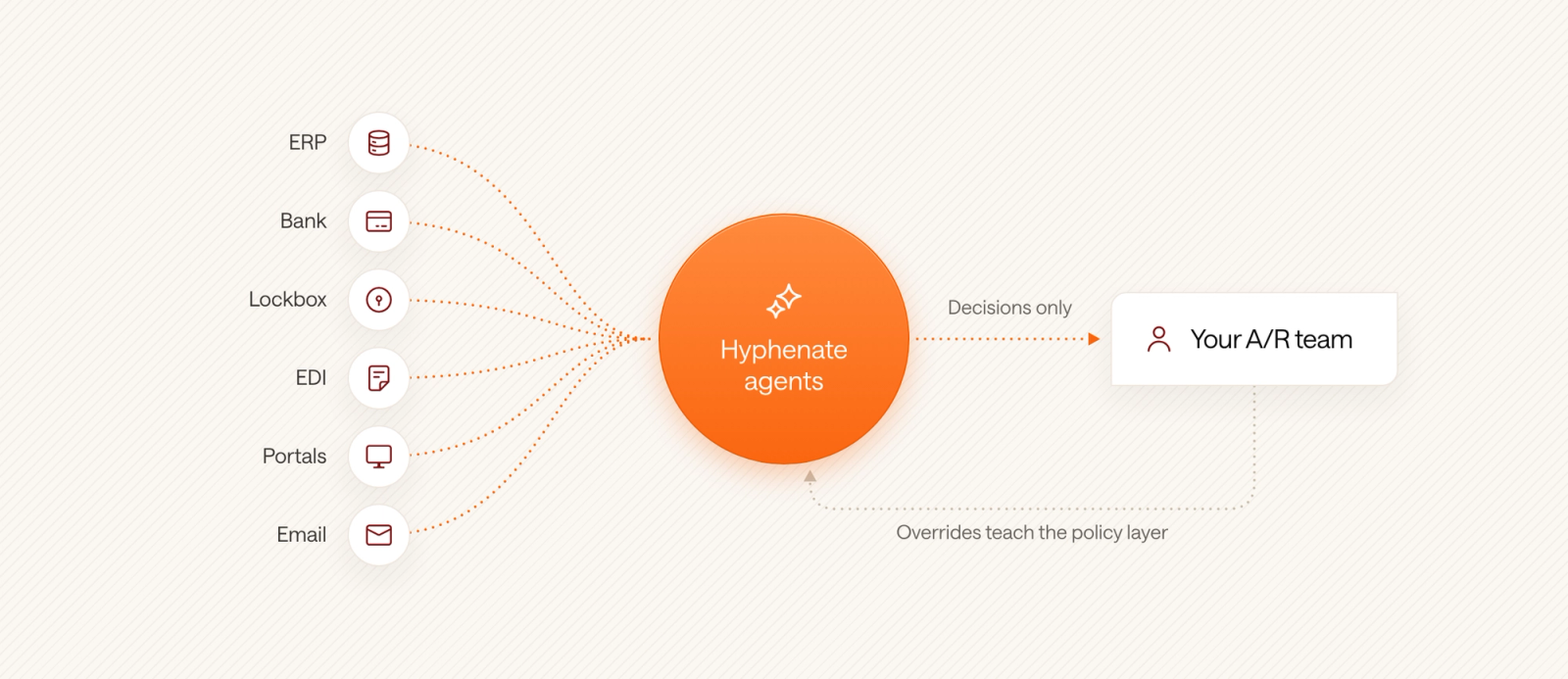
Hyphenate puts AI agents in front of your A/R team. They work every deduction the moment it arrives and send people only the transactions that need a decision.
Three things make this work in practice:
- It connects to the systems you already use. Hyphenate reads from your ERP, bank and lockbox files, EDI feeds, retailer portals and email, so there is no new data entry for your team.
- It learns your policies. Tolerances, write-off thresholds, customer-specific dispute processes and GL coding are built from your history and applied consistently to every deduction. Hyphenate’s Policy layer continues to learn as new, unique transactions are processed.
- People stay in control. Every automated decision is logged with the evidence behind it. Your team sets the guardrails, reviews exceptions and can override any decision. Each override teaches the system.
What changes for the business
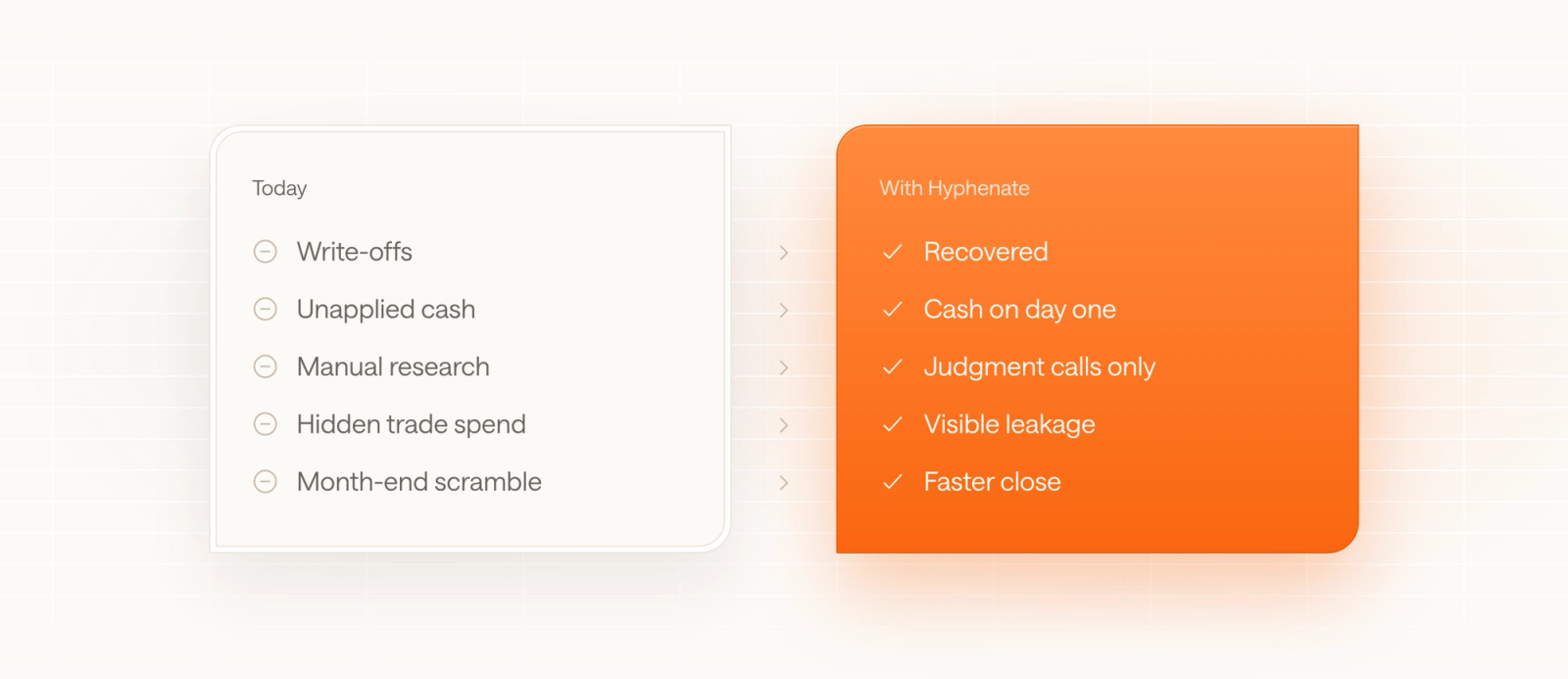
When routine deductions resolve themselves, the gains show up across finance, sales and operations.
- More money recovered. Invalid deductions are disputed while the window is still open, instead of aging into write-offs.
- Faster cash and cleaner DSO. Short payments are researched by Hyphenate on day one, so open balances stop piling up in unapplied cash and unresolved items.
- Leverage for the A/R team. Analysts spend their time on judgment calls, not processing transactions manually. The team scales with volume without scaling headcount.
- Real visibility into trade spend. Every deduction is classified consistently, so you can see which customers, promotions, distribution centers or carriers drive leakage and fix the root cause.
- A faster close. Valid deductions are matched to accruals and coded correctly as they happen, not reconciled in a scramble at month-end.
Let A/R start at the answer
Deductions and short payments will never disappear. What can disappear is the manual research that turns every short payment into a project.
Hyphenate does that research the moment a payment lands, so your A/R team starts every case at the answer instead of the question.
See it on your own data. Book a demo and we will show you how many of last quarter's deductions could have been resolved before anyone on your team touched them.
Subscribe to our newsletter to receive the latest from Hyphenate.